You can build a barndominium as a full-time home in North Georgia, but it is permitted as a house: it has to meet Georgia’s residential code, your county’s zoning and dwelling standards, and the county health department’s septic rules. Published third-party estimates put a turnkey barndominium in Georgia at roughly $140 to $210 per square foot before land, well, septic, driveway and site work, so the lot and the county decide more of the final number than the steel does.
Key Takeaways
- A barndominium can be a full-time North Georgia home, but it is permitted as a house under residential code, zoning and septic rules.
- Georgia's minimum standard since January 1, 2026 is the 2024 IRC with Georgia amendments.
- Zoning varies widely; Dawson County prohibits metal wall cladding in several residential districts but not RA or RRE.
- Published estimates put turnkey Georgia barndominiums at roughly $140 to $210 per square foot before land and site work.
- The lot and the county decide more of the final cost than the steel does.
Below is what the code, two North Georgia counties, the septic rules and the state erosion permit actually say, plus how kit, shell and turnkey builds compare.
What a barndominium is
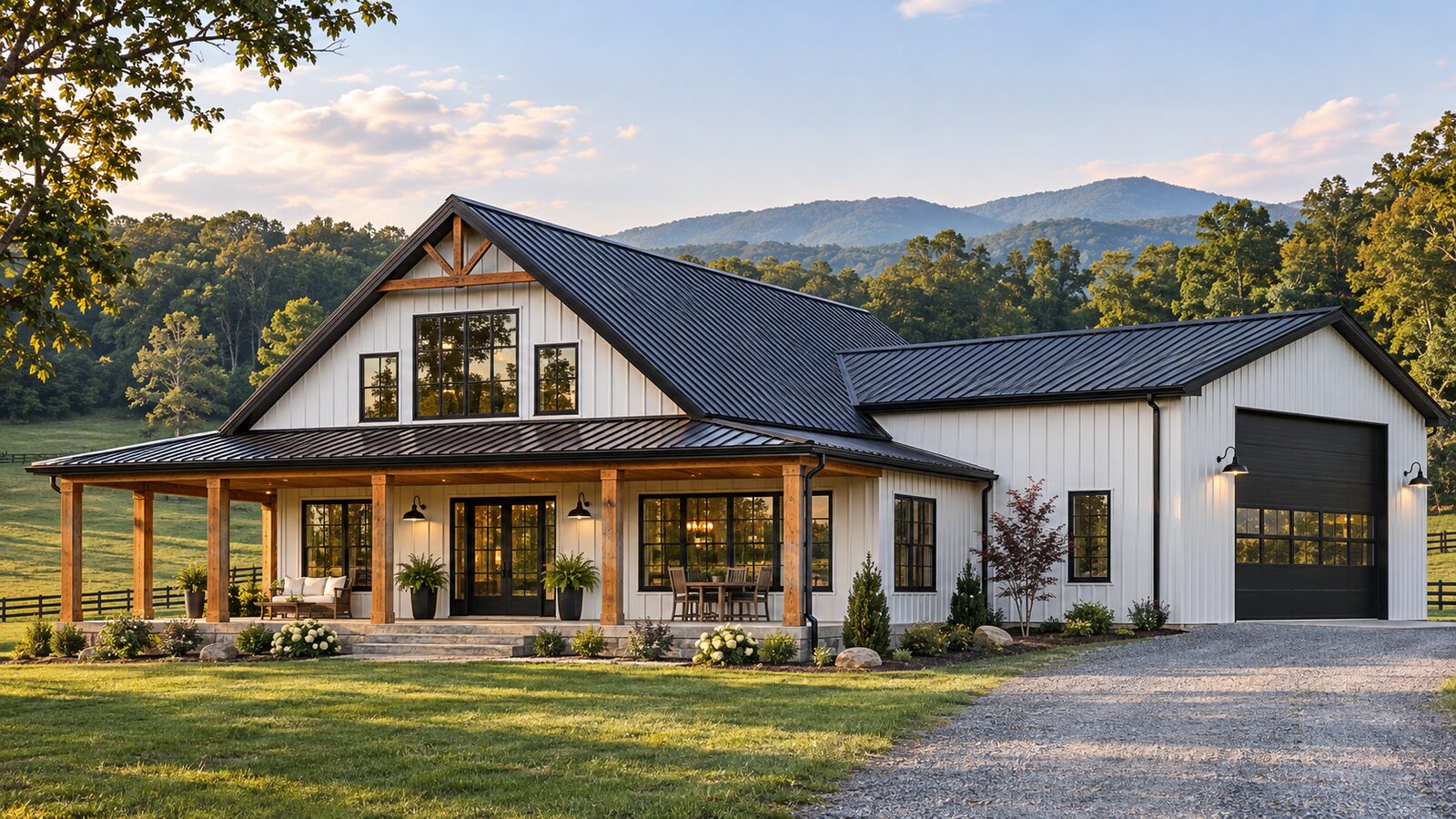
A barndominium is a home built with barn-style construction, usually a steel or post-frame shell with living space inside and, often, a shop or garage bay under the same roof. A 2026 Rockdale County zoning text amendment offers a useful plain-language definition: a detached single-family dwelling built with post-frame, metal-frame, conventional wood frame or similar methods, which may include attached storage, workshop, garage or hobby space, “provided the residential portion complies with all applicable building, fire, health, and zoning regulations” (Rockdale County text amendment).
That last clause is the whole story. The frame can be steel or wood posts. The living space is regulated like any other house.
Georgia’s residential code
Georgia builds one- and two-family homes under the International Residential Code with Georgia State Amendments. As of January 1, 2026, the state minimum standard is the 2024 IRC with Georgia amendments (Georgia DCA memo). The amendments delete the IRC’s own energy, plumbing and electrical chapters and substitute the Georgia State Minimum Standard Energy, Plumbing and Electrical Codes (Georgia IRC amendments, 2024 edition).
For a barndominium, that means the steel or post-frame structure still has to be designed for residential loads, and the living space gets the same insulation, plumbing, electrical and egress requirements as a stick-built home.
County zoning: two North Georgia examples
Zoning is where barndominium projects in Georgia most often stall, because each county writes its own rules. Two counties we work in show how far apart they can be.
Dawson County
Dawson County’s Land Use Resolution prohibits metal exterior wall cladding in several residential districts. The RT, RL, RS and RSR districts state that “vinyl, metal, and EIFS stucco exterior wall cladding of any kind is prohibited,” and RS-2 and RS-3 prohibit metal siding in their design standards. No such prohibition appears in the RA (residential agricultural) or RRE (residential rural estate) districts (Dawson County Code, Article III).
The same article says “non dwelling type structures shall not be connected to utilities and used as a dwelling,” and lists storage buildings and shipping containers among them. In plain terms: a metal storage building cannot be wired and plumbed into a house after the fact. A barndominium has to be permitted as a dwelling from the start.
In Dawson County, RA generally requires 5 acres and RRE requires 3 acres, which we cover on our Dawsonville and Big Canoe page.
Hall County
Hall County takes a different approach. Its Unified Development Code sets standards that every single-family dwelling must meet, and the list of acceptable siding includes “vinyl-covered or painted metal.” The same section requires:
- A permanent foundation built to the building code, with a slab or a masonry foundation or curtain wall enclosing the area under the ground floor
- A minimum roof pitch of 4:12 on all roof surfaces
- Roof coverings such as standing seam (noncorrugated) metal or corrugated metal that simulates standing seam
- A roof overhang of at least 6 inches on all sides, not counting gutters
Those standards are in Section 2.2.1 of the Hall County UDC, adopted September 10, 2026. Many low-slope metal building packages are designed below 4:12, so the roof pitch alone can rule out an off-the-shelf kit in Hall County.
Ordinances change, and districts within a county differ. Confirm the zoning of your parcel and the current text before you buy land or a building package.
Septic: the permit that comes first
Most rural North Georgia lots rely on septic. Under the Georgia Department of Public Health rules, no one may begin “physical development” of a lot that will use an on-site sewage system without first getting a construction permit from the county health department, and physical development includes site preparation, roads and well construction (GA DPH Chapter 511-3-1). Key points from the rules:
- The permit is issued only after a county site inspection shows favorable soil, absorption, groundwater and rock conditions
- The county board of health must approve or disapprove a complete application within 20 days
- A construction permit is valid for no more than 12 months
- A conventional or chamber system needs a septic tank of at least 1,000 gallons
For single-family lots, the state manual calls for at least three soil borings in the proposed absorption field and the duplicate (reserve) field area, dug to 72 inches unless a refusal layer is hit (GA DPH On-Site Sewage Manual, Section C). The house, shop bay, driveway and well all have to fit around those two field areas, which is why septic layout belongs at the start of design, not after the floor plan is set.
Grading, driveway and land disturbance
A barndominium with a shop bay tends to have a big footprint, and a long rural driveway adds more cleared ground. Georgia EPD’s construction stormwater general permits cover sites where construction will disturb one acre or more, or less than an acre when the lot is part of a larger common plan of development disturbing one acre or more (Georgia EPD NPDES fact sheet). Clearing, grading, excavating and filling all count as construction activity under the permit (GAR100001).
Pad, driveway, septic fields and any pasture clearing add up quickly. Counties and cities also run their own land disturbance programs, so ask your local issuing authority what applies to your lot even below an acre.
Foundation and slab
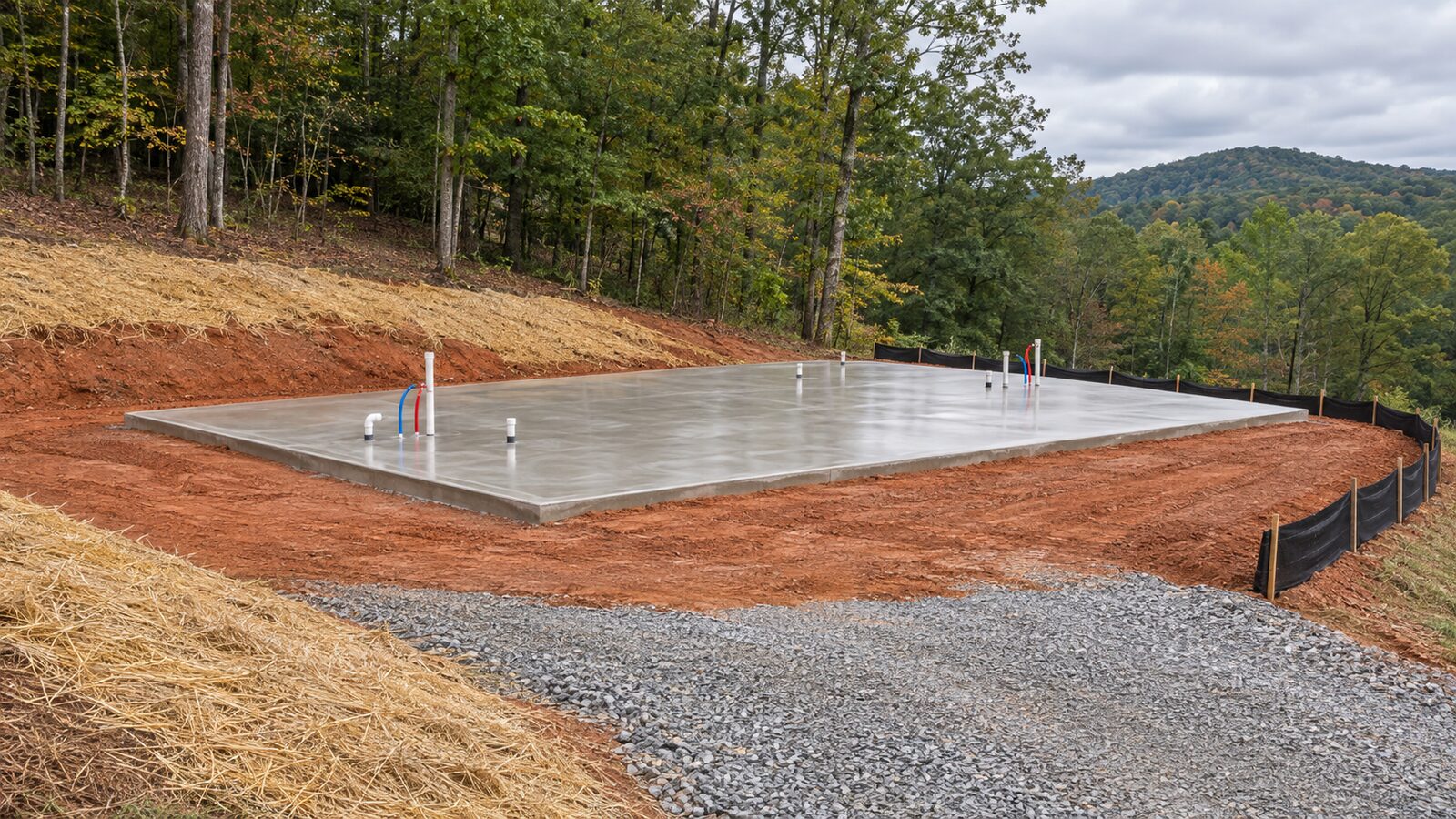
Most barndominiums sit on a concrete slab, and plumbing is roughed in before the pour, so the floor plan has to be final before concrete. Hall County’s dwelling standards, for example, require a permanent foundation with a slab or an enclosed masonry foundation wall (Hall County UDC). On a sloped North Georgia lot, the pad elevation, cut and fill, and where water goes around the slab are engineering decisions that affect cost as much as the building package does.
Financing, appraisal and insurance
Financing is usually workable, but the appraisal is the step to plan for. Fannie Mae’s Selling Guide says loans on unique or nontraditional housing are eligible “provided the appraiser has adequate information to develop a reliable opinion of market value,” and that both the appraiser and underwriter judge this case by case, depending on how different the home is and how many similar properties have sold nearby (Fannie Mae Selling Guide B4-1.3-05). Where few barndominiums have sold, that can mean a conservative value, so talk to a construction lender before you commit to land or plans.
Ask your insurance agent to quote the specific plan, including the shop bay, before you finalize financing.
Planning a Barndominium on Your Land?
Mack Development and Mack Engineering check your county's zoning, septic and site work first, then design and build the home around what the lot allows.
Talk to Mack About Your Lot or call (770) 212-0743What a barndominium costs to build
These are third-party published estimates, not Mack Development pricing. Barndo Finder’s 2026 state estimates put Georgia at $140 to $210 per square foot for a turnkey barndominium and $40 to $70 per square foot for an erected shell (Barndo Finder cost data, updated September 2026). Its national figures break down what each level includes and leaves out:
| Build type | Published national range (Barndo Finder) | 40×60 (2,400 sq ft) example | What it leaves out |
|---|---|---|---|
| Materials kit | About $17 to $36 per sq ft | $40,000 to $87,000 | Foundation, erection, everything inside |
| Erected shell | $45 to $75 per sq ft (median) | $108,000 to $180,000 | Mechanicals, insulation, all interior finish |
| Turnkey home | $145 to $215 per sq ft (median) | $348,000 to $516,000 | Land, well, septic, driveway, site work |
Source: Barndo Finder. Your number will depend on the lot, the finish level, how much of the building is heated living space versus shop, and the site work your county and soils require.
Kit, shell or turnkey custom build
- Kit: you buy the steel or post-frame package and arrange the slab, erection, trades and permits yourself. It looks cheapest on paper, but it is the version most likely to run into zoning issues like Hall County’s 4:12 roof pitch or Dawson County’s metal cladding limits.
- Shell: a builder erects and dries in the structure, and you manage the interior. You still carry the septic, grading, mechanical and finish work.
- Turnkey custom build: one team handles design, site work, permits, structure and finish to move-in. This is the route most lenders and county reviewers find easiest to follow, because one set of drawings ties the building to the site.
Step-by-step: building a barndominium in North Georgia
- Check the parcel. Confirm the zoning district and its dwelling standards: siding, roof pitch, minimum heated floor area, lot size and setbacks.
- Test the soil for septic. Get the county environmental health site evaluation and lay out the primary and reserve fields before you design the house.
- Plan water. Decide between public water and a well, and locate the well with the septic layout.
- Engineer the site. Set the pad, driveway, grading, drainage and erosion control, and determine whether the disturbed area reaches one acre.
- Design the building. Finalize the floor plan, the shop bay and the structural design to the 2024 IRC with Georgia amendments.
- Line up financing. Bring the plans, budget and site plan to a construction lender and talk through the appraisal.
- Permit. Submit for the septic construction permit, land disturbance coverage if needed, and the building permit.
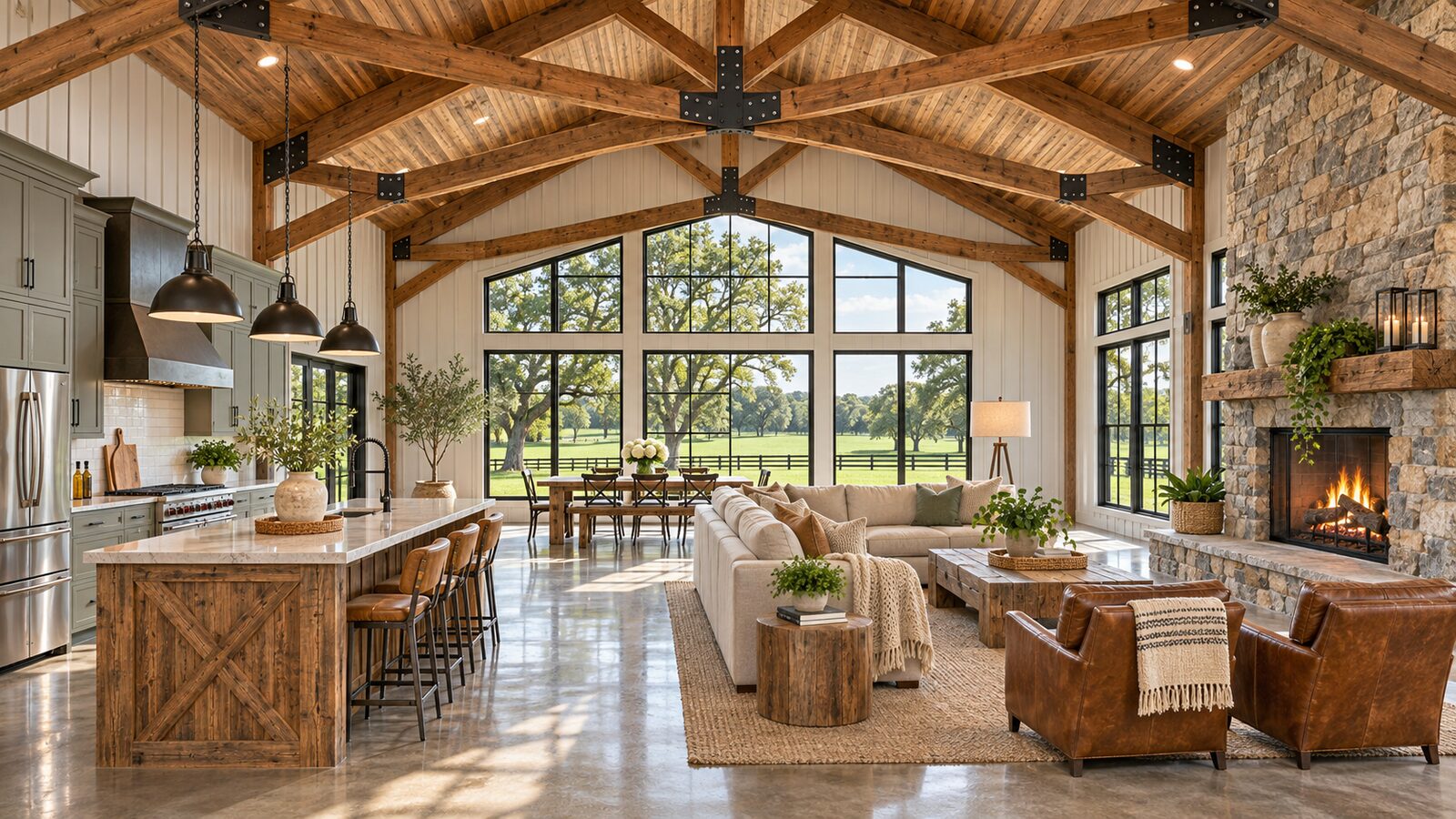
- Build. Erosion control, grading, plumbing rough-in and slab, structure, dry-in, mechanicals, insulation and interior finish, then final inspections.
Why site engineering comes before the steel
On a barndominium, the expensive surprises are rarely in the building package. They are in the lot: a septic field that won’t perc where you wanted the house, a driveway grade that needs more cut, or a zoning district that doesn’t allow metal siding.
Mack Development Group is a design-build custom home builder. Our sister firm, Mack Engineering, is a licensed Georgia civil engineering firm, and we price projects from an engineered site plan. Site feasibility covers zoning and setbacks, soil and septic suitability, stormwater and buffers, and driveway grade, and our Revit models can include grading, septic reserve and tree-save areas, as described on our custom build page. If you already own land, see building a custom home on your lot.
Frequently asked questions
Can a barndominium be a primary residence in Georgia?
Yes, when it is permitted and built as a dwelling. It has to meet the 2024 IRC with Georgia amendments and your county’s zoning. Dawson County, for example, says non-dwelling structures such as storage buildings cannot be connected to utilities and used as a dwelling, so the building must be permitted as a house from the start.
Do North Georgia counties allow metal siding on a house?
It depends on the county and district. Hall County lists painted or vinyl-covered metal as acceptable siding for single-family dwellings. Dawson County prohibits metal exterior wall cladding in its RT, RL, RS and RSR districts and metal siding in RS-2 and RS-3, but not in RA or RRE.
How much does a barndominium cost per square foot in Georgia?
Barndo Finder’s 2026 estimates put Georgia at $140 to $210 per square foot turnkey and $40 to $70 per square foot for an erected shell. Those figures exclude land, well, septic, driveway and site work, which can vary widely on rural lots.
Do I need a septic permit before I start grading?
On a lot that will use septic, yes. Georgia DPH rules say physical development, including site preparation and road building, cannot begin without a septic construction permit from the county health department.
Does a barndominium need a land disturbance permit?
Georgia EPD’s construction stormwater permit applies when construction disturbs one acre or more, or less than an acre within a larger common plan of development. Counties and cities can have their own land disturbance requirements, so check locally.
Start with the lot
If you are planning a custom barndominium in North Georgia, send us your parcel and what you have in mind. Call or text (770) 212-0743, email info@mackdevelopmentgroup.com, or contact Mack Development Group.